
Anderson County Traffic Ticket Records
Anderson County traffic ticket records document citations issued by law enforcement across Palestine and the surrounding county. These records are public and can be searched through Texas court systems, the county clerk, and online state tools. Whether you need to check a fine amount, confirm a court date, or verify case status, this guide covers the main ways to find what you need.
Anderson County Overview
How Traffic Tickets Work in Anderson County
Traffic tickets in Anderson County are Class C misdemeanors under Texas law. They carry fines but no jail time. Most tickets are handled by one of four Justice of the Peace courts, each serving a different precinct of the county. The Palestine Municipal Court handles violations that occur within city limits. State troopers, county deputies, and local police all write citations in this county.
When you get a ticket, the officer gives you a citation that lists the violation, your court date, and the court where you must appear. You have a few options: pay the fine, appear in court to contest it, or ask about a deferred disposition. Each choice has different results for your record and your license. Paying without going to court is treated as a guilty plea under Art. 27.14(c) of the Texas Code of Criminal Procedure, which means the conviction gets reported to DPS.
Anderson County has four JP precincts covering the rural parts of the county. The precinct where your citation was issued determines which court handles your case. The county clerk at (903) 723-7400 can direct you to the right court if you're not sure.
Search Anderson County Traffic Records
The Texas Office of Court Administration runs a public citation search tool called TOPICs. You can use it to look up traffic ticket records from many Texas courts, including Anderson County JP courts. The search at topics.txcourts.gov/CitationsPublic lets you find cases by citation number, defendant name, or driver license number.
Not every court uploads records to TOPICs right away. If you can't find a case there, call the JP court directly or visit the courthouse in Palestine. The county clerk's office can also help point you to the right JP precinct records. For cases in Palestine Municipal Court, contact the city directly for access to those records.
Records in these systems show case status, hearing dates, fine amounts, and whether the case is open or closed. You can use this to confirm a ticket was paid or to check whether a court date has passed.
The Texas DPS also keeps driver records that show traffic ticket convictions. These are separate from court records but useful if you want to see how citations affected a driving history. Driver records are available online for a fee.
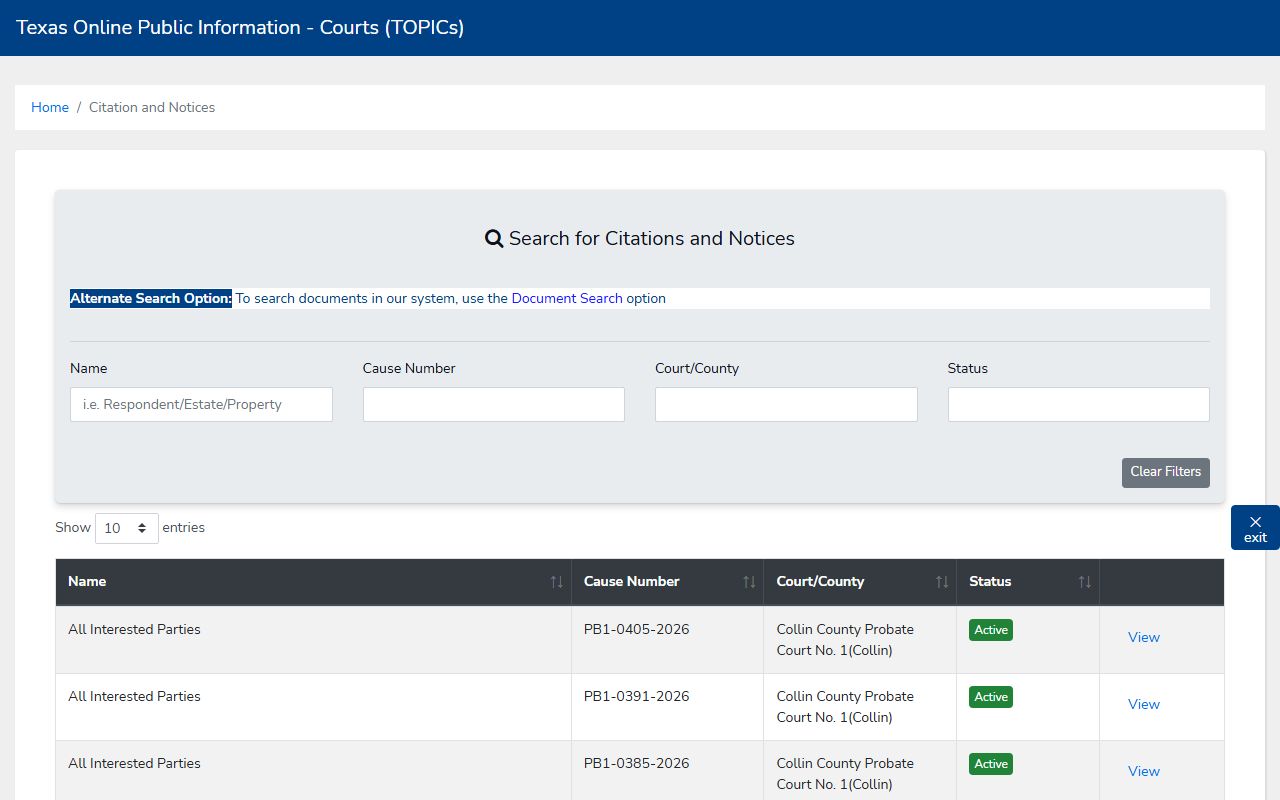
The TOPICs public citation search covers many Texas JP and municipal courts, giving you a fast way to check case status without calling the courthouse.
What a Traffic Ticket Record Contains
Each traffic citation in Anderson County is a record with several key fields. These include the citation number, the date and time the stop occurred, the location, and the officer's name and badge number. The record also lists the defendant's name, date of birth, and driver license number, plus the vehicle plate and description.
The violation section of the record shows the statute that was broken and a plain-language description of the offense. The fine amount may appear, along with any court costs added by state law. Once the case moves through court, the record is updated to show the outcome: guilty, dismissed, deferred, or pending.
These records are public in Texas. Anyone can request them from the court or search the state's online tools. Some older records may only be available in paper form at the courthouse.
Paying a Ticket or Resolving Your Case
Anderson County residents can pay traffic fines in person at the appropriate JP court or Palestine Municipal Court. Many courts now accept online payments through third-party portals. Call the court listed on your citation to confirm payment options and the exact amount owed, since court costs vary by court.
If you want to avoid a conviction on your record, ask about deferred disposition under Art. 45.051 of the Code of Criminal Procedure. This lets the court put your case on hold for 90 to 180 days. If you meet the conditions set by the judge, the case is dismissed. Conditions often include paying a fee and not getting another ticket during the waiting period.
A second option for eligible drivers is the Driving Safety Course (DSC), covered under Art. 45.0511. You take a state-approved course and the ticket gets dismissed. To qualify, you must request DSC before your court date, not hold a CDL, not have used DSC in the past 12 months in Texas, and not be charged with speeding more than 25 mph over the limit. You'll also need a Type 3A certified driving record from DPS, which costs $12 online or $10 by mail.
Texas DPS Driver Records
Your Texas driving record is maintained by the Department of Public Safety. Traffic ticket convictions reported by courts show up here. DPS offers several record types at different price points. A Type 2 record covers three years of history and costs $6.50 online or $6 by mail. A Type 3 shows your complete history for $7.50 online or $7 by mail.
If you need a certified copy for a court or employer, you'll want a Type 2A or Type 3A. For ticket dismissal through the driving safety course, the court requires a Type 3A certified complete record, which costs $12 online or $10 by mail. Mail requests go to Texas DPS, P.O. Box 149008, Austin, TX 78714-9008, and take up to three weeks to process.
Note: Texas eliminated its driver point system in 2019. Now, four or more moving violations in 12 months or seven or more in 24 months can trigger a license suspension review.
What Happens If You Don't Pay
Ignoring a traffic ticket in Anderson County has real consequences. If you miss your court date and don't pay, the court can issue a warrant for your arrest. The Texas OMNI program under Transportation Code Chapter 706 also comes into play. Courts report unpaid tickets to DPS, which then places a hold on your driver license renewal. You can't renew until you clear the debt, plus a $10 OMNI fee (or $30 for older cases).
The Texas Failure to Appear site lets you check whether your license has an OMNI hold and pay it online. Once cleared, DPS lifts the hold and you can renew. If you have multiple unpaid tickets, each one adds a separate OMNI fee.
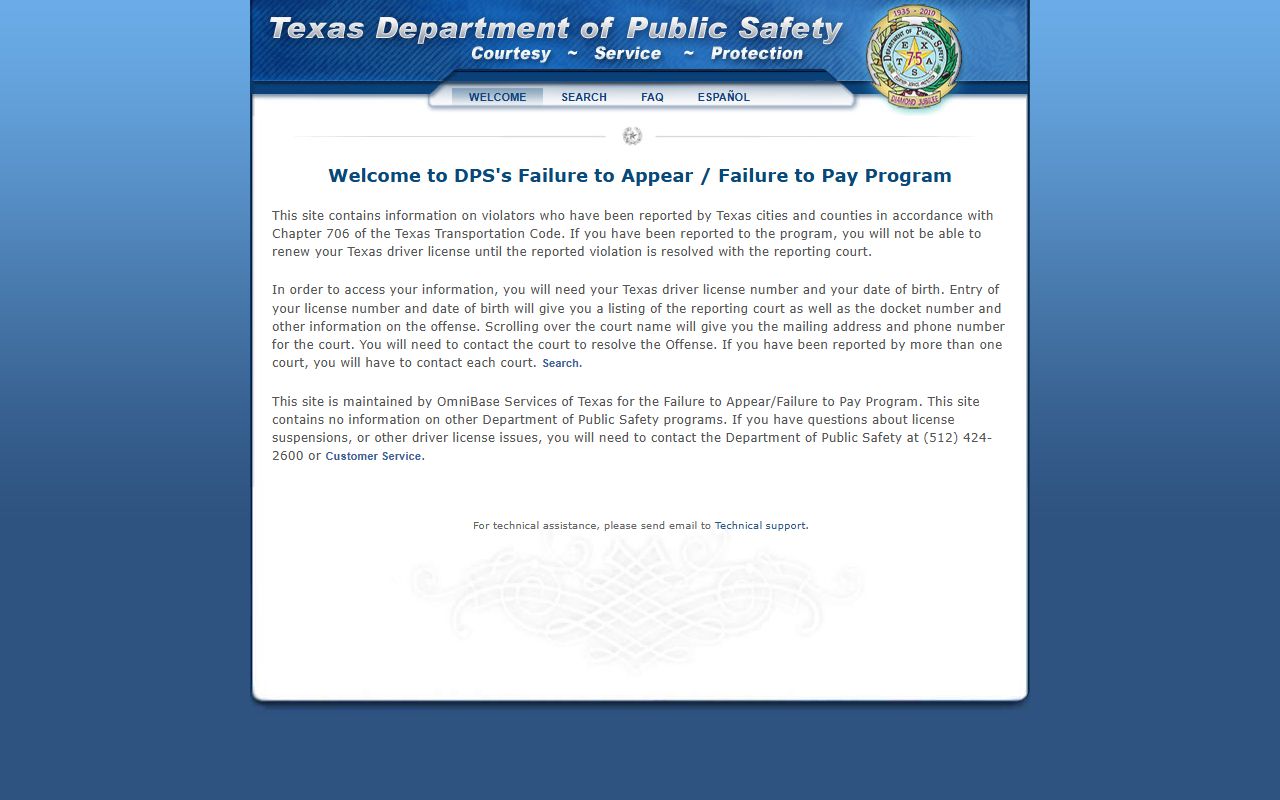
The Texas Failure to Appear program is how the state tracks unpaid fines and blocks license renewals. Checking your status here is a quick way to find any outstanding holds.
Nearby Counties
Anderson County borders several East Texas counties. You can find traffic ticket records for neighboring areas at these pages: